Comparison · Educational
Ceramic Braces vs Metal Braces
Same underlying mechanics, different bracket material. Ceramic brackets are tooth-coloured; metal brackets are stainless-steel.
Option A
Ceramic Braces
Tooth-coloured or clear brackets bonded to the front of teeth with the same wire mechanics as metal braces.
Option B
Metal Braces
Stainless-steel brackets bonded to the front of teeth, connected by an archwire. The most clinically versatile fixed appliance.
Book with Dr. Rockson Samuel at Indira Dental Clinic, Vellore
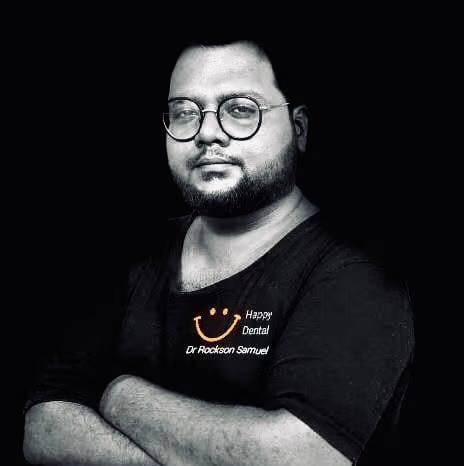
Dr. Rockson Samuel
Indira Dental Clinic, Vellore
4.915+ years experience
Quick verdict
Ceramic for aesthetics; metal for value and durability. Your case will fit either.
We deliberately do not name a universal winner. The right choice depends on your diagnosis and lifestyle — confirm with a qualified orthodontist.
Who should consider Ceramic Braces?
Ideal candidates
- Adults wanting a less visible fixed option
- Mild to complex cases needing fixed mechanics
- Public-facing professionals
Contraindications
- Severe bruxism (bracket fracture risk)
- Untreated periodontal disease
Who should consider Metal Braces?
Ideal candidates
- Mild to complex malocclusions
- Cases requiring precise 3D tooth control
- Patients who prefer non-removable, low-daily-effort treatment
Contraindications
- Severe metal allergies
- Untreated periodontal disease
- Patients unable to attend regular in-clinic adjustments
Side-by-side comparison
| Criterion | Ceramic Braces | Metal Braces |
|---|---|---|
| Visibility | Tooth-coloured, visibly less obvious than metal. | Silver brackets visible at conversational distance. |
| Comfort | Similar to metal braces; slightly larger bracket profile. | Initial tenderness for 3 to 5 days; occasional wire pokes. |
| Removability | Fixed | Fixed |
| Treatment duration | 12 to 30 months | 12 to 30 months |
| Oral hygiene | Care with staining foods; brackets themselves are stain-resistant on newer systems. | Requires more time; food traps around brackets need attention. |
| Food restrictions | Same restrictions as metal braces plus staining awareness. | Avoid hard/sticky/chewy foods; cut fruits into pieces. |
| Speech adaptation | Minimal impact after initial adjustment. | Minimal impact after initial adjustment. |
| Appointments | Every 3 to 5 weeks for adjustments. | Every 3 to 5 weeks for adjustments. |
| Digital planning | Optional indirect bonding and digital set-ups. | Optional indirect bonding and digital set-ups. |
| Retention / follow-up | Retainers required post-treatment. | Retainers required post-treatment; long-term wear at night. |
| Clinical suitability | Adults wanting a less visible fixed option; Mild to complex cases needing fixed mechanics; Public-facing professionals | Mild to complex malocclusions; Cases requiring precise 3D tooth control; Patients who prefer non-removable, low-daily-effort treatment |
| Maintenance | Interdental brushes and floss threaders daily. | Interdental brushes and floss threaders daily. |
| Illustrative cost range (INR) | ₹55,000 to ₹1,40,000 | ₹40,000 to ₹90,000 |
| Illustrative financing | Illustrative EMI from ~₹2,300/month over 24 months. | Illustrative EMI from ~₹1,700/month over 24 months. |
| Patient compliance | Not compliance-dependent | Not compliance-dependent |
Values are educational summaries — final clinical suitability is confirmed only after an orthodontist's examination.
Clinical differences
- Ceramic Braces — complexity
- moderate
- Metal Braces — complexity
- moderate
- Ceramic Braces — technology
- Ceramic or composite brackets; often clear archwires.
- Metal Braces — technology
- Conventional or self-ligating brackets, NiTi archwires.
Treatment process
- Ceramic Braces — appointments
- Every 3 to 5 weeks for adjustments.
- Metal Braces — appointments
- Every 3 to 5 weeks for adjustments.
- Ceramic Braces — digital workflow
- Optional indirect bonding and digital set-ups.
- Metal Braces — digital workflow
- Optional indirect bonding and digital set-ups.
- Ceramic Braces — follow-up
- Retainers required post-treatment.
- Metal Braces — follow-up
- Retainers required post-treatment; long-term wear at night.
Lifestyle
- Appearance (A)
- Tooth-coloured, visibly less obvious than metal.
- Appearance (B)
- Silver brackets visible at conversational distance.
- Comfort (A)
- Similar to metal braces; slightly larger bracket profile.
- Comfort (B)
- Initial tenderness for 3 to 5 days; occasional wire pokes.
- Speech (A)
- Minimal impact after initial adjustment.
- Speech (B)
- Minimal impact after initial adjustment.
- Eating (A)
- Same restrictions as metal braces plus staining awareness.
- Eating (B)
- Avoid hard/sticky/chewy foods; cut fruits into pieces.
- Cleaning (A)
- Care with staining foods; brackets themselves are stain-resistant on newer systems.
- Cleaning (B)
- Requires more time; food traps around brackets need attention.
Timeline & maintenance
- Ceramic Braces — duration
- 12 to 30 months
- Metal Braces — duration
- 12 to 30 months
- Ceramic Braces — maintenance
- Interdental brushes and floss threaders daily.
- Metal Braces — maintenance
- Interdental brushes and floss threaders daily.
Typical cost considerations
Ceramic Braces
₹55,000 – ₹1,40,000
Illustrative EMI from ~₹2,300/month over 24 months.
Insurance: Generally not covered; case-by-case reimbursement under OPD/cosmetic riders.
Metal Braces
₹40,000 – ₹90,000
Illustrative EMI from ~₹1,700/month over 24 months.
Insurance: Generally not covered; some group employer plans reimburse in medically indicated cases.
Ranges are illustrative national estimates. Final quotations depend on complexity, city, brand and clinic. Always request a written treatment plan and quotation before deciding.
Decision support
Answer five short questions to see which option better matches your preferences. This is educational only — it does not replace an orthodontist's examination.
How important is treatment being invisible?
How budget-sensitive are you?
Can you wear an appliance 20 to 22 hrs/day, every day?
Which best describes you?
What is your primary goal?
Decision aids on this page are educational only. They cannot replace an in-person orthodontic examination, imaging or a clinician's judgement. Please book a consultation to receive a personalised treatment plan.
Visual summary
Illustrative comparison across five decision axes. Higher does not mean better, read each note.
Best-suited candidates
Ceramic Braces
- Adults wanting a less visible fixed option
- Mild to complex cases needing fixed mechanics
- Public-facing professionals
Metal Braces
- Mild to complex malocclusions
- Cases requiring precise 3D tooth control
- Patients who prefer non-removable, low-daily-effort treatment
When one option may be preferred
Situations favouring Ceramic Braces
- You value discretion at work and prefer ceramic braces because it is tooth-coloured, visibly less obvious than metal..
- You can commit to the wear-time discipline Ceramic Braces requires (same restrictions as metal braces plus staining awareness.).
- You want the digital planning workflow: optional indirect bonding and digital set-ups..
Situations favouring Metal Braces
- Your case has clinical complexity where metal braces may be more predictable (conventional or self-ligating brackets, niti archwires.).
- You prefer a fixed appliance so compliance is not a variable, initial tenderness for 3 to 5 days; occasional wire pokes..
- Your budget aligns better with Metal Braces (illustrative emi from ~₹1,700/month over 24 months.).
Trade-offs
| Area | Ceramic Braces | Metal Braces |
|---|---|---|
| Appearance | Tooth-coloured, visibly less obvious than metal. | Silver brackets visible at conversational distance. |
| Comfort | Similar to metal braces; slightly larger bracket profile. | Initial tenderness for 3 to 5 days; occasional wire pokes. |
| Speech | Minimal impact after initial adjustment. | Minimal impact after initial adjustment. |
| Eating | Same restrictions as metal braces plus staining awareness. | Avoid hard/sticky/chewy foods; cut fruits into pieces. |
| Predictability | Complexity handled: moderate | Complexity handled: moderate |
Lifestyle considerations
Client-facing job / on-camera work
Consider the more discreet option and confirm with your orthodontist. Ceramic Braces: Tooth-coloured, visibly less obvious than metal.. Metal Braces: Silver brackets visible at conversational distance..
Frequent travel / irregular schedule
Check appointment cadence. Ceramic Braces: Every 3 to 5 weeks for adjustments.. Metal Braces: Every 3 to 5 weeks for adjustments..
Contact sports or musical instrument use
Discuss safety and comfort implications with your orthodontist before deciding.
Wedding or exam deadline
Duration varies with case complexity, do not choose an option purely on advertised speed.
Maintenance differences
| Area | Ceramic Braces | Metal Braces |
|---|---|---|
| Daily maintenance | Interdental brushes and floss threaders daily. | Interdental brushes and floss threaders daily. |
| Cleaning | Care with staining foods; brackets themselves are stain-resistant on newer systems. | Requires more time; food traps around brackets need attention. |
| Follow-up | Retainers required post-treatment. | Retainers required post-treatment; long-term wear at night. |
Typical treatment timelines
Timelines are illustrative averages. Your orthodontist confirms the plan after diagnosis.
- Ceramic Braces: typically 12 to 30 months.
- Metal Braces: typically 12 to 30 months.
Illustrative cost differences
On midpoint estimates, Metal Braces is illustratively lower by ~₹32,500. Do not decide on this alone, your written treatment plan and quotation are the only reliable numbers.
Ceramic Braces
₹55,000 to ₹1,40,000
Metal Braces
₹40,000 to ₹90,000
Questions to ask an orthodontist
Take this list to your consultation. Answers should be case-specific and in writing.
- Is my case clinically suitable for both Ceramic Braces and Metal Braces, or only one?
- What is the evidence base for the option you are recommending for my diagnosis?
- What is the expected duration, and what factors could extend it?
- How many refinements or replacements are included, and what do additional ones cost?
- What retention protocol will follow, and for how long?
- Can I see anonymised before-and-after cases similar to mine?
- What is your clinic's escalation plan if treatment does not progress as planned?
- Will I receive a written treatment plan and itemised quotation before I commit?
Common misconceptions
Myth: DIY mail-order aligners deliver the same outcome.
Reality: Unsupervised treatment carries documented clinical and legal risk. In-person orthodontic supervision is the standard of care.
Myth: Insurance in India covers orthodontics as standard.
Reality: Most Indian health-insurance plans exclude orthodontic and cosmetic dental care unless an OPD or employer rider is attached.
Myth: Removable aligners are always more comfortable than braces.
Reality: Comfort varies by individual, both cause soreness after each activation or tray change.
Myth: Only teenagers benefit from orthodontic treatment.
Reality: Adults form a large share of modern orthodontic patients in India.
Structured decision tree
An educational walkthrough. Diagnosis with an orthodontist always overrides this tree.
Have you had an in-person orthodontic diagnosis?
Yes →
Is a near-invisible appearance a top priority for you?
Yes →
Can you wear a removable appliance ~22 hours/day and follow the plan without slipping?
Yes →
→ Discuss Ceramic Braces
You value discretion and can commit to compliance, Ceramic Braces is worth exploring. Final call is your orthodontist's.
No →
→ Discuss Metal Braces
A fixed option removes compliance risk. Confirm suitability at your consultation.
No →
Has your orthodontist flagged your case as clinically complex?
Yes →
→ Discuss Metal Braces
Complex cases often benefit from a fixed appliance's predictability. Your clinician confirms the final plan.
No →
→ Both options are open, decide on lifestyle
Bring both options to your consultation and weigh cost, comfort and duration.
No →
→ Book a consultation first
No comparison can substitute for a clinical exam. Diagnosis determines which options are safe for your case.
Frequently compared alternatives
Invisible Braces vs Metal Braces
Common follow-up question at consultations.
Invisible Braces vs Ceramic Braces
Shares one of the options on this page.
Clear Aligners vs Ceramic Braces
Frequently compared by patients researching this decision.
Clear Aligners vs Metal Braces
Useful adjacent comparison when finalising your plan.
The intelligence above is educational and generated from illustrative clinical parameters. Where evidence is limited or your case is unusual, a qualified orthodontist's in-person diagnosis is required before making any decision.
Frequently asked questions
- Which is better, Ceramic Braces or Metal Braces?
- Neither is universally better. Suitability depends on your diagnosis, lifestyle and orthodontist's recommendation. This page presents the evidence-based differences so you can discuss them at your consultation.
- Is Ceramic Braces more expensive than Metal Braces?
- Illustrative ranges: Ceramic Braces ₹55,000 to ₹1,40,000; Metal Braces ₹40,000 to ₹90,000. Final quotation depends on complexity, city and clinic.
- How long does treatment take with Ceramic Braces vs Metal Braces?
- Ceramic Braces: typically 12 to 30 months. Metal Braces: typically 12 to 30 months. Duration depends on individual clinical factors.
- Are Ceramic Braces and Metal Braces covered by insurance in India?
- Orthodontic and cosmetic dental care is not covered by most Indian health-insurance policies. Some employer plans and OPD/cosmetic riders may reimburse partially. Always check policy wording.
- Can I switch between Ceramic Braces and Metal Braces mid-treatment?
- Switching is sometimes possible but adds cost and time. The safer approach is to discuss both options thoroughly with your orthodontist before starting.
Research references
- Clinical Practice Guidelines — American Association of Orthodontists (2023)
- Oral health fact sheet — World Health Organization (2023) · source
- Orthodontic treatment for prominent upper front teeth in children — Cochrane Systematic Review (2018)