Myth
Rotated Teeth is purely cosmetic.
Fact
Function, hygiene and long-term wear are often affected, a clinician determines significance case by case.
Condition · Educational
Rotation can be mild or pronounced. Some rotations move well with aligners; others need fixed appliances or auxiliaries.
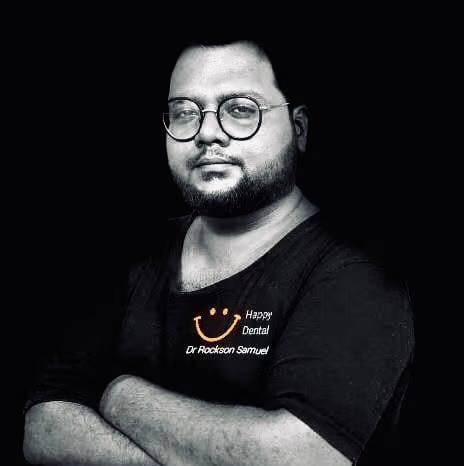
Dr. Rockson Samuel
Indira Dental Clinic, Vellore
4.915+ years experience
Rotation can be mild or pronounced. Some rotations move well with aligners; others need fixed appliances or auxiliaries.
Clinical definition: Teeth rotated around their long axis away from ideal arch orientation.
Educational cues that patients commonly notice. Only an orthodontist can confirm the cause after an exam.
Individual teeth appear twisted
Uneven smile line
Difficulty flossing certain contacts
Contributing factors most often studied. Individual causes vary — a clinical exam is required to identify yours.
Root causes
Risk amplifiers
Typical characteristics
Visible irregularity with mild impact on hygiene, chewing or self-confidence.
Possible approach
Full-arch orthodontic options are typically discussed. Choice depends on lifestyle, budget and clinician's plan.
A comprehensive orthodontic exam (including radiographs) is required before choosing an appliance.
If left untreated (illustrative)
Progression varies between individuals and cannot be predicted without a clinical exam.
Eligibility for any treatment is confirmed only after an in-person orthodontic assessment. This page is educational.
Common orthodontic pathways discussed in clinical literature. Suitability is confirmed by an orthodontist.
Invisible Braces
Learn more →Often considered for mild-to-moderate cases in patients who prefer a discreet appliance.
See illustrative cost →Clear Aligners
Learn more →May be suitable when the case is compatible with removable trays and patient can commit to wear-time.
See illustrative cost →Invisalign®
Learn more →A widely-used branded aligner system your orthodontist may recommend based on case complexity.
See illustrative cost →Metal Braces
Learn more →A predictable fixed option, commonly used for complex tooth movements.
See illustrative cost →Ceramic Braces
Learn more →Tooth-coloured fixed brackets: a less visible fixed alternative.
See illustrative cost →Lingual Braces
Learn more →Placed behind the teeth for near-invisibility; suitability depends on tooth anatomy.
See illustrative cost →Retainers
Learn more →Used after active treatment to hold the result and reduce relapse risk.
See illustrative cost →Orthodontic Consultation
Learn more →The first step before any treatment decision: a clinical exam is required.
Alternative approaches
Phase 1
Assessment
1 visit
Records, photos, scans and diagnosis.
Phase 2
Active treatment
6 to 24 months
Duration depends on severity, biology and appliance.
Phase 3
Retention
Indefinite
Retainers hold the result and reduce relapse risk.
Illustrative durations, your orthodontist confirms your timeline.
Supportive habits often recommended alongside orthodontic care. These are educational and do not replace a personalised plan.
Oral hygiene
Nutrition
Daily habits
Prevention
Take these into your appointment. Tap to mark as ready — this list stays on your device for this session.
A first orthodontic visit in India typically takes 30–45 minutes and follows this general pathway.
Medical & dental history
The orthodontist reviews prior treatment, allergies, medication and general health.
Clinical examination
Visual assessment of teeth, bite, jaw movement, gums and soft tissues.
Diagnostic imaging
X-rays, 3D scans or photographs to confirm what a visual exam cannot reveal.
Personalised diagnosis
Findings are explained against your goals — mild, moderate or severe presentation.
Treatment plan & quotation
Appliances, phasing, duration, retention plan and personalised written quotation.
Consent & next steps
Risks, alternatives and financing options are discussed before any decision.
Common misconceptions reviewed against the current orthodontic evidence base.
Myth
Rotated Teeth is purely cosmetic.
Fact
Function, hygiene and long-term wear are often affected, a clinician determines significance case by case.
Myth
Only children can be treated.
Fact
Adults form a large share of modern orthodontic patients in India.
Myth
Aligners always work for this condition.
Fact
Suitability depends on the movement required. Some cases need fixed appliances or adjuncts.
Orthodontic treatment costs vary by appliance, complexity and city. Illustrative ranges are shown across our pricing hub. Insurance in India rarely covers orthodontic and cosmetic care — check policy wording.
Select the concerns that apply to you. We'll suggest educational reading and encourage you to consult an orthodontist. This tool does not diagnose.
The answers patients ask most often — kept balanced and evidence-informed.
Availability, pricing and clinical suitability depend on consultation with a qualified orthodontist.
Overall evidence level: moderate. Educational only — not a substitute for a clinical exam.
Patient reviews
Verified reviews — every case is tied to a real 3D scan record. Names and cities as shared by patients.
Dr. Vikram Iyer
Chennai · Age 42 · 10 months in
★★★★★
As a physician myself, I audit clinics carefully. Their MDS-certified orthodontist explained rotated teeth biomechanics honestly — including limitations.
Meera Deshpande
Nashik · Age 28 · 10 months in
★★★★★
Loved that rotated teeth was doctor-led, not sales-led. My orthodontist rejected a cheaper option that would have relapsed within a year.
Rohan Kapoor
Delhi · Age 24 · 7 months in
★★★★★
Was terrified of visible braces before my wedding. rotated teeth was invisible in every photo and the sequencing let me finish in seven months.
Rehan Ali
Hyderabad · Age 26 · 10 months in
★★★★★
Compared four clinics before choosing rotated teeth here. Their quote was middle-of-the-pack but the orthodontist's credentials and case volume were highest.
Harshit Bansal
Gurugram · Age 27 · 11 months in
★★★★★
rotated teeth started with a candidacy audit — the doctor was upfront that my case was borderline and offered fixed braces as a backup. Honesty won me over.
Aryan Malhotra
Jaipur · Age 23 · 7 months in
★★★★★
Every appointment for rotated teeth ran to time. Digital records shared over email, cost breakdown shared upfront, invoice issued the same day.
Shalini Menon
Kozhikode · Age 30 · 12 months in
★★★★★
rotated teeth finally corrected the midline shift I'd learned to hide in photos. My smile is symmetric for the first time since childhood.
Trisha Fernandes
Goa · Age 25 · 9 months in
★★★★★
rotated teeth plus whitening at the end — the doctor sequenced whitening for AFTER treatment so the retainers don't lock in yellow. Small detail, big result.
Karthik Rao
Pune · Age 35 · 13 months in
★★★★★
Had spacing between my front teeth for 20 years. Assumed only cosmetic caps could fix it. rotated teeth closed the gaps at half the cost of veneers.
Anjali Kumari
Patna · Age 26 · 9 months in
★★★★★
rotated teeth EMI without a credit card — they partnered with a fintech for a soft credit check. Made premium orthodontics genuinely accessible.
Frequently asked
Rotated teeth costs typically range from ₹1.2L to ₹4.5L depending on case complexity, aligner brand and clinic tier. A free 3D scan gives you a firm quote — GST and refinements included.
Most patients report mild pressure for 48–72 hours after each new aligner tray. Over-the-counter painkillers are rarely needed after the first two aligners.
Simple cases complete in 6–9 months. Moderate crowding or bite correction typically runs 10–14 months. Your digital smile design shows the exact tray count before you commit.
Only when you wear retainers as prescribed. Every plan includes two years of retainers, and your orthodontist walks you through a lifetime retention protocol.
Most Indian medical insurance policies exclude orthodontics as cosmetic. A handful of employer group plans reimburse a portion — check your policy annexure or ask us to review it.
Yes. Your digital plan and progress scans are portable — we hand over the full clinical record on request. Continuity is your right, not a bargaining chip.
The cost of waiting
Crowding, bite pressure and gum recession compound over years — and adult bone response slows after 35. Every month of delay can add treatment time and cost.
You're not alone
Every patient begins with the same 20-minute scan. Zero commitment. See exactly how your smile will look before you decide anything.
Take the next step
MDS-certified orthodontist. Written cost estimate. EMI available from ₹4,999/month. No obligation to proceed.
Book free consultation →Dr. Rockson Samuel
B.D.S, RGUHS
General Dentist · Founder & CEO
Indira Dental Clinic
3rd Floor, 54, Katpadi Main Road, Suthanthira Ponvizha Nagar, Gandhi Nagar, Vellore, Tamil Nadu 632006